

If you have ever typed “hearing test near me” into Google and then closed the tab without booking, you are not alone. For many people, that search happens quietly, late at night, after a family gathering, after someone says, ‘you didn’t hear that?’, after the television volume creeps up another notch! And most people think about their hearing long before they take action. Hearing changes rarely arrive suddenly.
Most people think about their hearing long before they take action. Hearing changes rarely arrive suddenly. Yes, they appear gradually, almost politely, asking for little adjustments from you. You lean forward in busy restaurants or position yourself strategically at the dinner table, or laugh along even when you missed part of the story or convince yourself that crowded places are difficult for everyone. And you know the brain is remarkably adaptable. It fills in gaps, it works harder and compensates. That is why hearing loss can develop for years before you book a hearing test.
World Hearing Day on 3rd March 2026 is a reminder that hearing health deserves the same routine attention as eyesight or dental care. We would not hesitate to book an eye test if words started to blur, and yet with hearing, many people wait. At Hear4U, we see this every day. We meet people who have quietly managed for years before finally seeking a ‘hearing test near me’, and almost every one of them says the same thing afterwards: “I wish I had done this sooner.”
Early checks are not about pressure but about clarity; they are about reassurance and understanding what is happening and making an informed decision, if any are needed at all. If uncertainty has been the reason, you have delayed booking, let us guide you through exactly what happens during a hearing test and why taking that first step is simpler than you think.
Key Takeaways
Why Hearing Checks Matter
One of the most common things we hear in our clinics is, “I think my hearing is fine, but I just wanted to check,” and that is exactly the right mindset. As you have understood, hearing loss rarely announces itself dramatically. It develops gradually over many years. Because the brain adjusts to subtle changes, many people do not recognise the shift straight away. Instead, they adapt their behaviour.
You may start avoiding phone calls in noisy environments, might feel more tired after social events because concentrating on conversation requires extra effort, and may blame others for mumbling, when in reality, certain frequencies are harder to detect. Often, it is family members who notice first and they comment that the television seems louder or mention that you ask for repetition more frequently. Sometimes they encourage you to search for a ‘hearing test near me’, even when you feel unsure.
Beyond simple communication, hearing health influences emotional well-being and social confidence. When hearing becomes challenging, some people unconsciously withdraw. They contribute less to discussions. They attend fewer gatherings. Over time, this can affect mood, self-esteem, and engagement. Research increasingly highlights connections between untreated hearing loss and cognitive strain. When the brain works harder to decode sound, it has fewer resources available for memory and processing. Early assessment helps reduce that strain.
Booking a hearing test is not about labelling yourself with hearing loss, but it is about checking in with your health, just as you would with blood pressure or vision. Even if your results show normal hearing, you gain reassurance and a professional baseline. That baseline becomes invaluable in future years, as it allows audiologists to accurately track even small changes. For many patients at Hear4U, the greatest relief comes not from treatment, but from understanding, clarity replaces uncertainty, and information replaces assumption. And often, that first search for a “hearing test near me” turns out to be one of the simplest yet most empowering health decisions they make.
Your Appointment at Hear4U
Many people imagine a hearing test as something clinical or intimidating. In reality, your visit to Hear4U begins with a simple conversation. From the moment you arrive at one of our local clinics, you are welcomed by a team that understands hearing care is personal. We are independent hearing specialists, and that independence allows us to focus on what is right for you rather than pushing a particular solution.
Our expert audiologists will begin by asking about your experiences. Have you noticed difficulty in background noise? Do you experience ringing in your ears? Has anyone close to you mentioned changes? We will also ask about your work environment, hobbies, and medical history. This discussion helps us build a clear picture of how your hearing functions in everyday life. There is no rush: this part of the appointment is about listening to you.
The Ear Examination
Before we begin the hearing test itself, we always start by looking inside your ears. Your audiologist will use an otoscope, which is a small handheld instrument with a light and magnifying lens. This allows us to examine the ear canal and eardrum safely and clearly. We are checking for anything that could affect your hearing before formal testing begins. The most common finding is earwax build-up; earwax is completely normal, it protects the ear by trapping dust and debris. However, in some people, it can build up and create a blockage. When this happens, sound cannot travel efficiently down the ear canal to the eardrum. The result can feel like muffled hearing, fullness in the ear, or reduced clarity.
If we see wax that is likely to affect your hearing, we will explain this to you in simple terms. At Hear4U, we provide professional earwax removal using microsuction. Microsuction is a safe, controlled method carried out under direct visual guidance; there is no flushing or syringing involved. In many cases, once the wax is removed, hearing improves immediately, and some patients who come in after searching for a hearing test near me discover that wax removal is all that was needed. If your ears are clear, we move on to the hearing assessment.

What You Will Experience During the Hearing Test
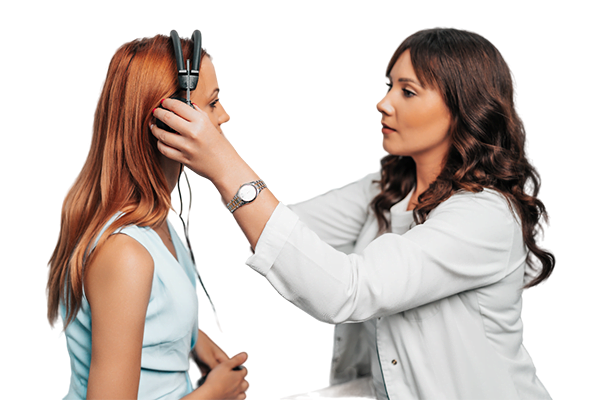
The hearing test itself is very straightforward. You will be seated in a quiet room or sound-treated area and asked to wear headphones. Through these headphones, you will hear a series of tones at different pitches and volumes. When you hear a sound, even if it is very faint, you press a button. The purpose of this part of the test is to measure the softest sounds you can hear across a range of frequencies. These frequencies represent the different pitches we encounter in everyday life, including speech.
There are no trick elements, and no, you are not being judged. You are simply responding to what you hear, and if you are unsure whether you heard a sound . If you are unsure whether you heard a sound, it is fine to respond. The test is designed to gather accurate information over several presentations of sound. Once tone testing is complete, we often carry out speech testing. This one involves listening to recorded words at comfortable and softer levels. Sometimes background noise is introduced to reflect real-world listening situations. Speech testing helps us understand not only whether you hear sounds, but also how clearly you understand words. This is particularly useful if you have noticed difficulty in group conversations or busy environments. The full assessment usually takes between 30 and 60 minutes and throughout the appointment, your audiologist will guide you and answer any questions you may have. For many people, the experience is much simpler than they expected and often, the uncertainty beforehand feels bigger than the test itself.
Understanding Your Results
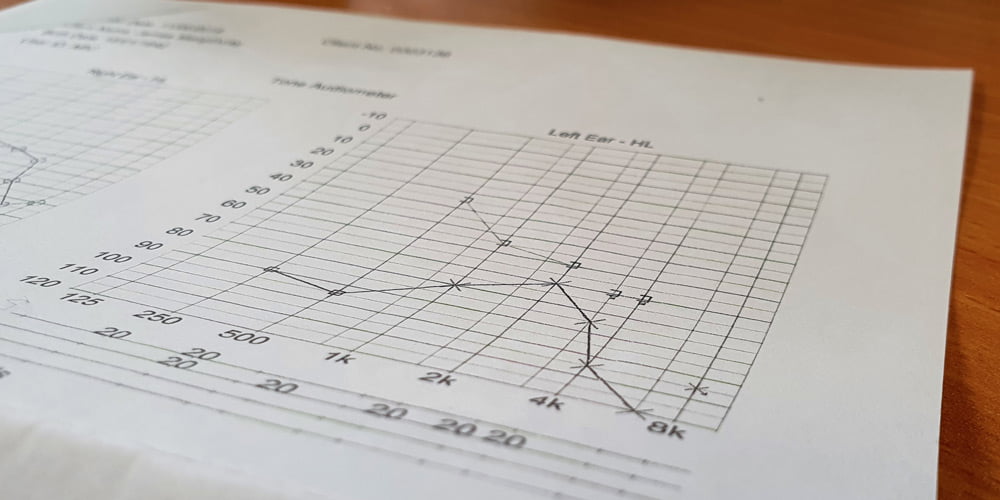
Once your hearing assessment is complete, our audiologist will go through the results with you in detail. You will be shown your audiogram, this is a chart that records the softest sounds you were able to hear at different pitches. The vertical side of the chart shows volume, from very soft to very loud sounds and the horizontal side shows pitch, from low tones to high tones. Our team takes time to explain what this means in practical terms. For example, we might show you where everyday sounds such as birdsong, speech, or traffic sit on the chart, and how that relates to your hearing levels.
If your hearing is within the normal range, we will reassure you. We will advise on how often you should return for monitoring, particularly if you are over 55 or work in noisy environments. Having a baseline result is valuable, since it allows us to compare future tests accurately. If there is hearing loss, we will explain the type and degree clearly, as hearing loss varies from person to person. Some people have difficulty hearing higher-pitched sounds, such as children’s voices or certain consonants in speech. Others may hear sound but find it difficult to understand speech clearly, especially in background noise.
We relate your results back to the listening situations you described earlier in the appointment. This helps everything make sense in real-life terms. If treatment or support is appropriate, we will discuss your options calmly. At Hear4U, recommendations are based on your lifestyle, priorities, and level of hearing difficulty. We explain hearing aid technology in straightforward language, including rechargeable options, discreet designs, and features that help in background noise or support tinnitus. There is no pressure to make a decision on the spot. Some people choose to go ahead with support straight away, while others prefer time to consider their options. Our role is to guide you with accurate information so you can make a decision you feel comfortable with.
Does a Hearing Test Hurt?
This is one of the questions we are asked most often, and to answer it, a hearing test does not hurt. There are no injections, no invasive procedures, and no discomfort. You are simply listening to sounds through headphones and responding when you hear them. The ear examination uses a small light to look inside the ear canal and is also painless.Most patients tell us afterwards that the appointment felt easier than they expected. Often, the anxiety beforehand is greater than the experience itself.
If you have been putting off searching for a hearing test near me because you are worried about discomfort, you can be reassured that the process is safe, straightforward, and carried out by experienced professionals who prioritise your comfort throughout.
World Hearing Day 2026: Our Commitment to the Community
World Hearing Day on 3rd March 2026 is more than a date in the calendar. It is a global initiative to raise awareness of hearing health and the importance of early detection. At Hear4U, we are proud to play our part within our local communities. Our clinics across Leicester, Hinckley, Newark, Rothwell and the surrounding areas are committed to making hearing care accessible and supportive.
On World Hearing Day, our focus is simple: we want to encourage people who have been unsure or hesitant to take that first step. Whether you need a full hearing assessment, earwax removal, tinnitus advice, or simply reassurance, our team is here. We believe community healthcare means being approachable, transparent, and consistent. Many of our patients have trusted us for years, returning not only for hearing tests but for ongoing aftercare, hearing aid servicing, and advice.
When Should You Book a Hearing Test?
You do not need to wait until hearing loss feels obvious or severe. In fact, many people who benefit from a hearing assessment would not describe their hearing as “bad”, they describe it as tiring. They mention that conversations in groups require more concentration than they used to, and they notice that they prefer quieter environments, they may turn the television up slightly higher than before, or ask others to repeat themselves more often. All these are early signs that your hearing may have changed.
If you are over the age of 55 and have not had a recent check, it is sensible to book one, even if you feel you are managing well. Hearing can change gradually over time, and routine testing allows us to monitor that change properly. You should also consider a hearing test if you experience ringing or buzzing in your ears, known as tinnitus, or if family members have commented on your hearing. Often, those closest to you notice subtle changes first. A baseline test is valuable at any age; it gives you a clear record of your current hearing levels. If you return in future years, we can compare results accurately and identify even small changes early. For many people, typing hearing test near me into a search engine is the moment they decide to stop guessing and start understanding. That first step is not dramatic, it is simply responsible healthcare.
Ongoing Support Beyond the Test
A hearing assessment is not the end of the process. It is the beginning of understanding.
At Hear4U, we support patients at every stage of their hearing journey. Some people require nothing more than reassurance and periodic monitoring and others may need earwax removal to restore clarity. For patients with hearing loss, we provide careful guidance through available options. Our services include professional earwax removal, tinnitus counselling, hearing aid fittings, device servicing and repairs, accessories, and structured aftercare appointments, because follow-up care is important. Hearing needs can change, and adjustments help ensure you continue to hear comfortably in everyday situations.
We are independent hearing specialists, and this means we are not tied to a single manufacturer. We recommend solutions based on your hearing results, your lifestyle, and your priorities. Whether you need advanced background noise support, rechargeable technology, or something simple and discreet, the focus remains on what suits you. Hearing care is ongoing, and we remain available long after your first appointment.
Simple Step That Makes a Difference
Hearing shapes how you experience daily life and it affects conversations at the dinner table, phone calls with family, background sounds in nature, and the small details that make more moments meaningful. When hearing changes, even slightly, it can alter how connected you feel. Addressing it early helps maintain confidence and participation in the things that matter to you.
World Hearing Day on 3rd March 2026 is an opportunity to pause and prioritise your hearing health. Whether you are looking for reassurance or practical support, your local Hear4U clinic is ready to welcome you with professional, straightforward care. Booking your appointment is a simple step that can make a big difference in your life. Your hearing deserves attention, and our team is here to support you, clearly and honestly, at every stage.
FAQs
Q. How much does a private hearing test cost in the UK?
The cost of a private hearing test varies depending on the provider and what is included in the appointment. Some clinics offer complimentary assessments, while others charge a fee that may be deducted from hearing aid purchases. It is always best to contact your local clinic directly for current pricing and availability.
Q. Do I need a GP referral for a hearing test?
No. You do not need a GP referral to book a private hearing test; you can contact your local hearing clinic directly and arrange an appointment at a convenient time.
Q. What is the difference between an NHS hearing test and a private hearing test?
An NHS hearing test is provided through your GP referral pathway and may involve waiting times depending on demand. A private hearing test typically offers faster access, longer appointment times, and a wider choice of hearing technology if treatment is required.
Q. Can earwax cause temporary hearing loss?
Yes. Earwax build-up is one of the most common causes of temporary hearing reduction. When wax blocks the ear canal, sound cannot travel effectively to the eardrum. Professional earwax removal often restores hearing clarity immediately.
Q. How often should adults have their hearing checked?
Adults over the age of 55 are generally advised to have their hearing tested every 2 years. Younger adults should consider testing sooner if they notice changes, experience tinnitus, or work in noisy environments.
Q. What types of hearing loss can a hearing test detect?
A hearing test can identify conductive hearing loss, sensorineural hearing loss, or a combination of both. The results help determine whether the cause may be wax, middle ear issues, or changes within the inner ear.